

FAQ: « Why don’t you recommend Windows
as operating system, as everyone else does ? »
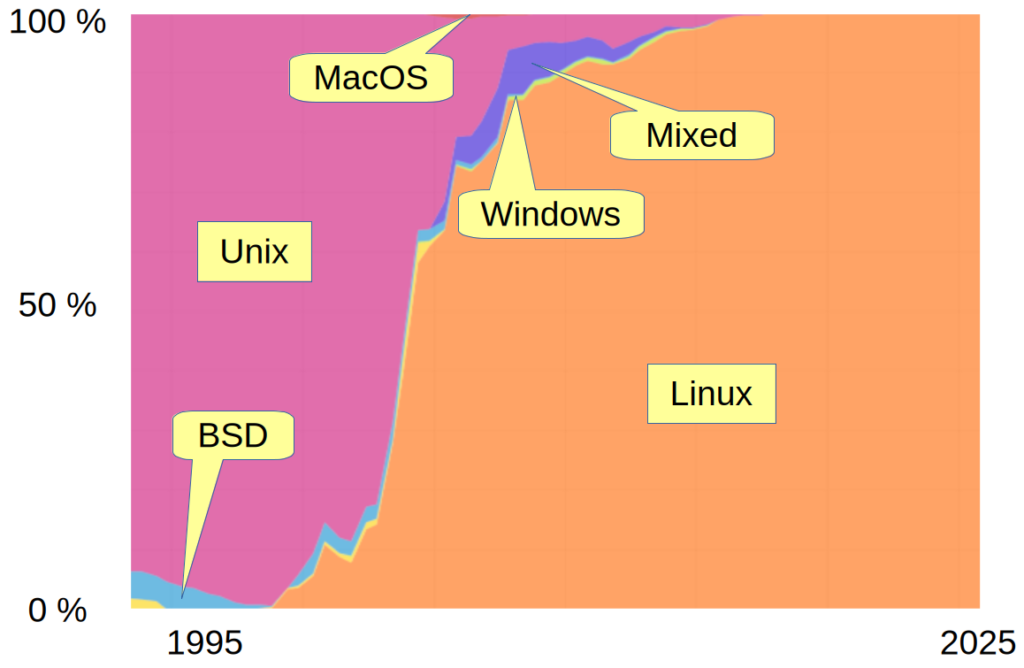
First of all, not “everyone is using Windows“. Linux is, by far, the most widely used operating system in the world, and has been for more than 10 years.
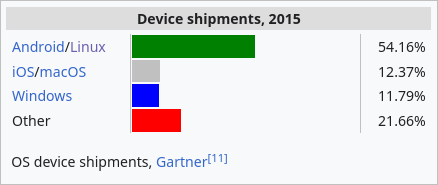
Source: Gartner
Aside of that, there are many reasons why Windows is not suitable for this purpose.
1° Performance considerations.
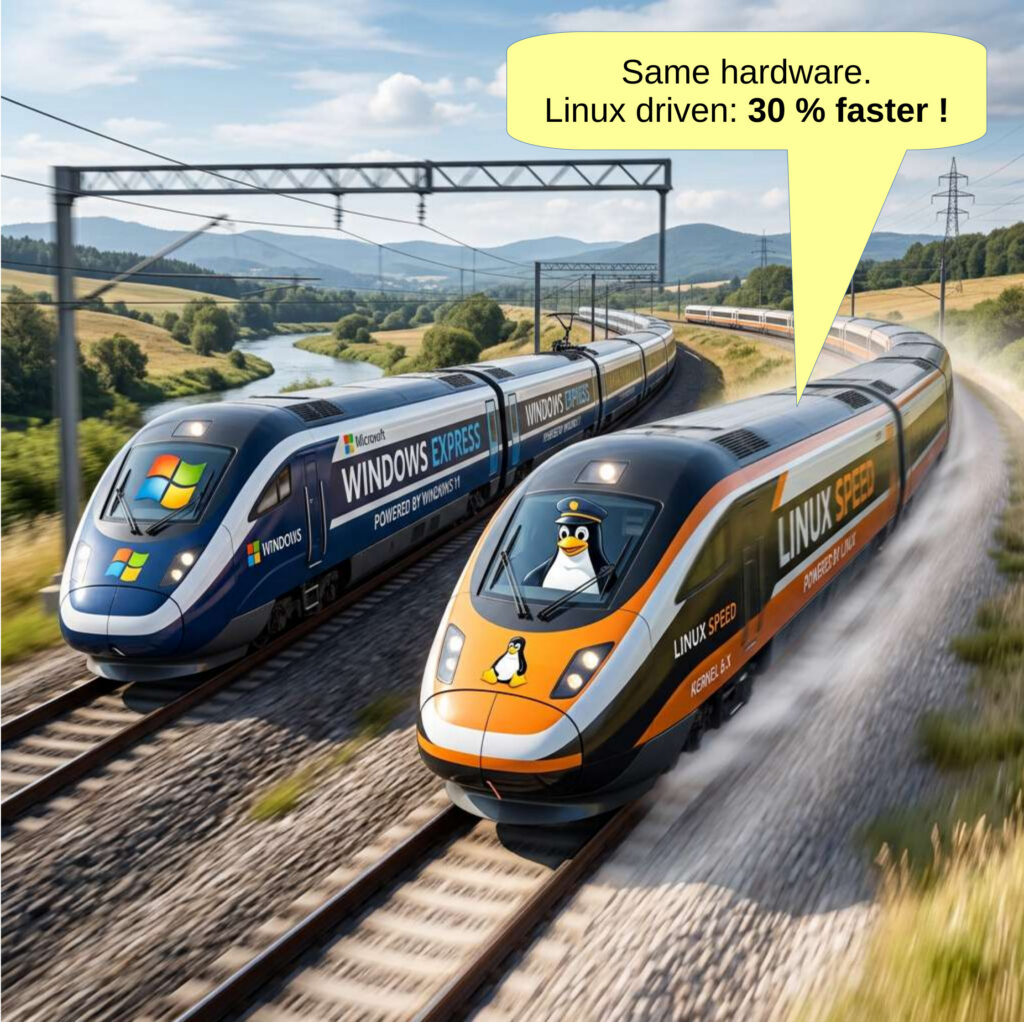
Years ago, Oracle was looking for the best platform (operating system) on which to run its famous RDBMS. The company carried out comparisons between two installations of the same version of the Oracle database, on the same hardware, but running on Windows and Linux respectively. The results showed a performance gap of around 30% ! As Oracle is a US-based company, it contacted Microsoft to ask for advice on the internal Windows settings that would help to reduce this gap.
Microsoft’s response was as follows:
« Read the Microsoft Windows licence terms carefully:
you are not permitted to compare the performance of our software
with that of another ! »
Oracle therefore published the results and switched to Linux, which it has continued to recommend ever since. Many other demanding and innovative companies have made the same choice; even Microsoft has switched to Linux to run its own cloud (Azure, publicly stated on September 2015) and now proposes and supports its own Linux distribution.
Windows suffers from numerous issues that hinder application software efficiency. These include the “stack traces” technique designed to prevent stack overflow attacks, as well as its artificial intelligence-based services, the hidden activities of Windows Defender, its background telemetry services, its microkernel architecture, which involves multiple layers to provide a basic service (such as opening a file), the overhead associated with its legacy APIs (NTDLL/WIN32) required for backward binary-code compatibility, its less efficient management of memory and swap space, its less efficient thread management, its less customizable process prioritization system, its less efficient file systems, its less efficient network stack and interrupt handling…
Even an identical wireless interface is faster on Linux than on Windows.
Furthermore, numerous configuration parameters are tunable under Linux (swappiness, vfs_cache_pressure, scheduling policies, NVMe driver settings, Ethernet interface settings, file system settings, …), enabling numerous performance improvements that are not available under Windows, due to its proprietary nature (closed-source code). Linux is also available in ‘real-time’ versions, which are ideal for situations where system latency is critical.
Linux exists since 1992.
So how does it handle backwards compatibility issues better than Windows ?
Linux has a highly efficient and well-designed library version management system, inherited from the Unix tradition. Furthermore, software can be recompiled (as its source code is generally available) to adapt to new API versions. There is therefore no requirement for long-term binary backward compatibility within the Linux ecosystem.
Windows, on the other hand, may offer better performance for gaming, as it is optimized for interactive software designed natively for Windows, featuring proprietary GPU drivers, such as games or single-user applications that are heavily reliant on the graphical user interface, as well as for software published by Microsoft itself, since these are developed with knowledge of undocumented features/API of the operating system (an obstacle to free and undistorted competition).
This is why 100% of the top 500 more powerful computer systems in the world are running on Linux, since years !
2° Features
For years, indeed decades, Linux has natively offered essential features for industrial-grade applications, where real-time performance and high availability are required, such as:
- KVM: a high-performance kernel-based virtualisation system, with direct execution of privileged code (Ring 0) and direct hardware access (PCI-passthrough, …)

- Several journaling file systems, ensuring that data remains intact even in the event of a power outage, some of them providing also CoW powers.

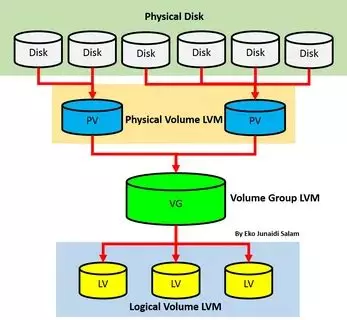
- Logical Volume Management (LVM), enabling hot resizing of volumes (virtual disks)
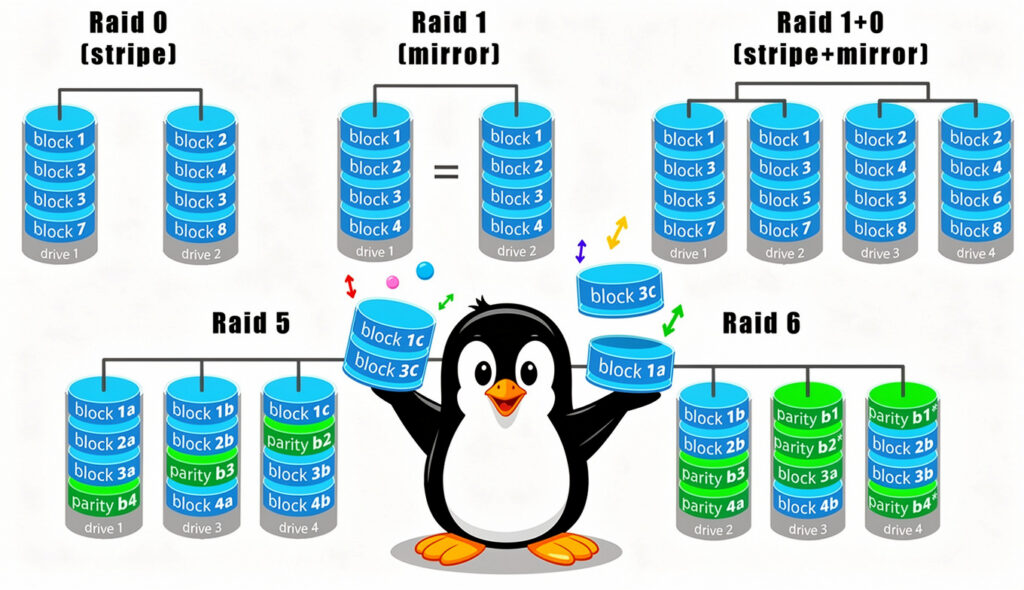
- Software RAID, generally more efficient than hardware RAID, which ensures your data can be recovered on alternative hardware, even in the event of a major disaster (no dependency on a specific hardware RAID controller)
- High-performance file system caching techniques, such as BCache or LVM cache pool devices, enabling the simultaneous use of very fast NVMe drives and high-capacity but slower storage devices.
- Real-time schedulers
- Control over task priority levels
- Native network interface aggregation (bonding)
- Native out-of-band remote access to the operating system (serial interface), including during the boot process
- Full bootable system-level backups, including hot snapshots, without any third-party software (rsnapshot and/or KVM snapshots, …)
and much more…
As a result, there are now no alternatives for embedded or real-time applications. Linux is the kernel of choice for routers, switches, servers and access points, as well as for cars, watches, smartphones, tablets, set-top boxes, smart TVs, programmable logic controllers and, soon, your connected microwaves and fridges !

3° Security
Windows is prompt to get viruses and ransomware.
It has long been claimed that this was because ‘it was the most widely used operating system on the Internet (which has not been true for many years) and that hackers therefore targeted it as a priority. This claim is totally false, as Linux now runs on around 90% of devices connected to the Internet, and still does not require any antivirus software, except maybe to detect files dropped onto it by infected Windows devices when used as a file server.
There are technical reasons why Windows is prone to infections: poor architectural choices at the operating system level, amongst other things, but that is beyond the scope of this article. The fact is that Linux is far more resistant to all kinds of software attacks, though this should not lead you to lower your guard, as the main threat to a computer system resides in its users (internal attacks or misuse)!
Legal issues…
Aside of that, the US legislation makes Windows (as well as any other operating system published by an US-based company)
unfitted for almost any use.
And here is why:
US legislation (primarily the Cloud Act, supplemented by the Patriot Act) extends its jurisdiction to any computer running a US operating system: these laws allow the US authorities to access data, even if the computer is located outside the United States, provided that the operating system was distributed by a US company.
US authorities can demand access to data via court orders or bilateral agreements (such as those provided for under the Cloud Act), but they can also access this data directly via the connections that these systems maintain (at least on a regular basis) for updates and “telemetry” (e.g. Microsoft, Google or Apple cloud services).
They do not need to justify their decision, and in any case, you probably won’t even notice it. The only restriction applies to cases where « there is a reasonable likelihood that the data belongs to a US citizen »…
To avoid this situation, opt for an open-source operating system supplied by a non-US distributor and a self-hosted infrastructure.

4° Long-term sustainability
Unlike Windows, Linux runs on virtually all hardware architectures (ARM, Power, AMD, RISC-V, Alpha, …) This means it will survive the bankruptcy of any of these manufacturers (such as Intel, which is not safe from this).
Linux relies on open-source libraries and tools (primarily the GNU ecosystem), such as Libc, the gcc compiler, etc. These programmes are and will remain available on new platforms (such as HarmonyOS), including those that have not yet been introduced, as their source code is accessible; they will therefore simply be recompiled for this purpose.
Note: when the first 64-bit Intel processor, the Itanium Merced, became available, the only operating system that could be used to test it was… Linux, because the kernel had been cross-compiled for a processor that didn’t exist yet !
Linux is the operating system ready for the future.
Scada-LTS is primarily developed in Java, a programming language and software environment based on a published standard, which has several open-source implementations, such as OpenJDK; it is therefore also protected against any potential bankruptcy of Oracle.

Scada-LTS is supplied ready for use on Linux, both on Intel & AMD platforms (“IBM PC-compatible” architecture) and on ARM-based Raspberry Pi devices, as well as on Windows/Intel.
For all the reasons above, We strongly encourage you to not use Windows in a production environment. We provide the Scada-LTS installation files for Windows solely for convenience and for evaluation purposes. However, the Windows version of Scada-LTS benefits from our full professional expertise and is designed to be industrial-grade software, just like the other versions.