GPL or not GPL ?
What is GPL versus FreeSoftware ?
Free Software is a category of software licenses as defined by the Free Software Foundation. You can find explanation about it here.
The GPL (General Public License) is one of the many software licenses that meet the requirements to be classified as a Free Software license.
It is the license actively promoted by the GNU organisation.

Its particularity is that it promotes the principle of CopyLeft.
The Copyleft clause specifies that you cannot remove or change the GPL from GPL-licensed source code. The goal is to extend the GPL license across the entire Free Software ecosystem through a process often called “contagion”: if you obtain software (and thus its source code) under the GPL, you must distribute it—and any derivative works—under the GPL as well.
If you link a GPL-licensed program with other software (using a linker), the other software must also be licensed under terms compatible with the GPL. As a result, the combined work can only be distributed under the GPL. In this way, the GPL progressively encourages more software (and its source code) to be released under its terms, which is precisely its intended purpose.
An example of this principle can be found in “Copyleft: Pragmatic Idealism“ by RIchard Stallman.
Consider GNU C++. Why do we have a free C++ compiler? Only because the GNU GPL said it had to be free. GNU C++ was developed by an industry consortium, MCC, starting from the GNU C compiler. MCC normally makes its work as proprietary as can be. But they made the C++ front end free software, because the GNU GPL said that was the only way they could release it. The C++ front end included many new files, but since they were meant to be linked with GCC, the GPL did apply to them. The benefit to our community is evident.
Consider GNU Objective C. NeXT initially wanted to make this front end proprietary; they proposed to release it as .o files, and let users link them with the rest of GCC, thinking this might be a way around the GPL’s requirements. But our lawyer said that this would not evade the requirements, that it was not allowed. And so they made the Objective C front end free software.
Those examples happened years ago, but the GNU GPL continues to bring us more free software.
The Linux kernel is released under the GPL license.
Similarly, the GNU ecosystem, when combined with the Linux kernel, forms the GNU/Linux Operating System: a complete operating system that includes libraries, real-time support, preemptive multitasking, native virtualisation, virtual memory management, logical volumes, distributed and journaling file systems, software RAID, a network stack, graphical user interfaces (GUIs), compilers, debuggers, and more. The entire system is licensed under the GPL, making it FreeSoftware. It is widely supported and used by both the community and major corporations (such as IBM, Huawei, Novell, Intel, NVidia, Amazon, Google, Google, and even Microsoft), ensuring its long-term sustainability.
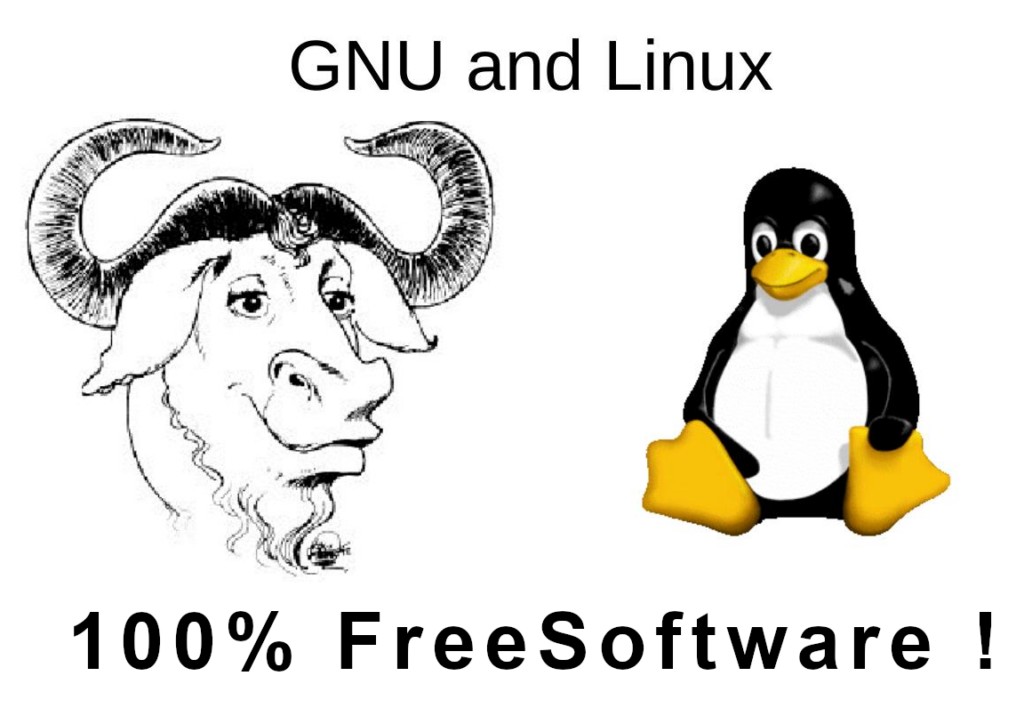
GNU/Linux is the operating system powering 100% of the world’s top 500 most powerful computer systems (as of November 2017), according to data from top500.org:
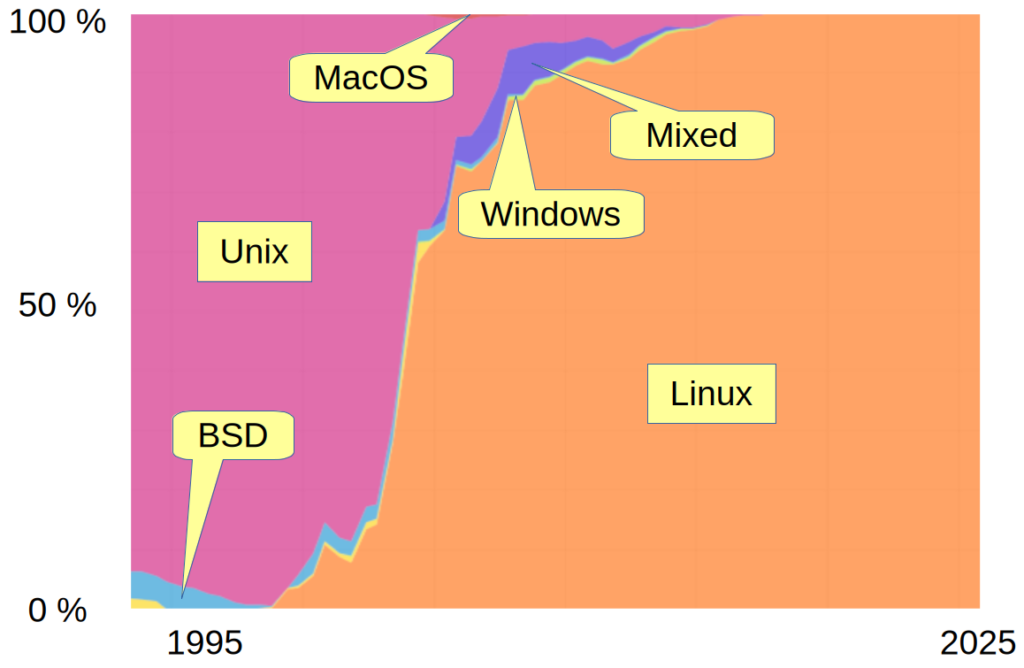
OS Family Share in the Top 500 Supercomputers Worldwide
(source: top500.org)
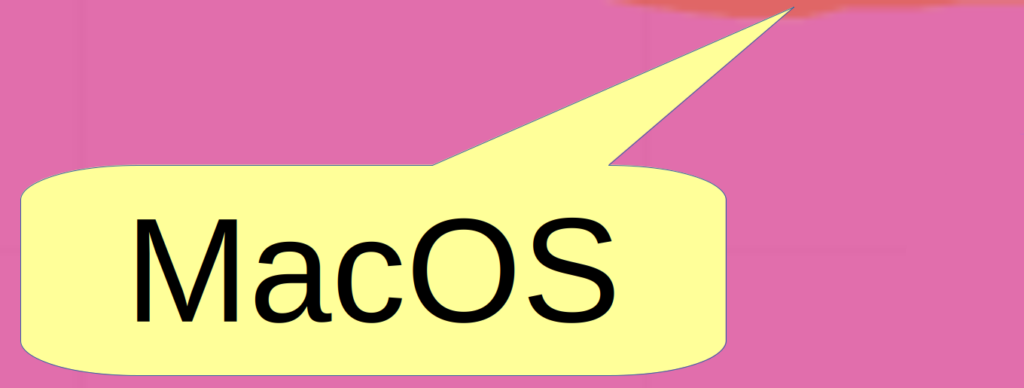
MacOS once reached a peak of 5 out of 500 (1%) around 2005.
Here is the zoomed view of the previous picture:
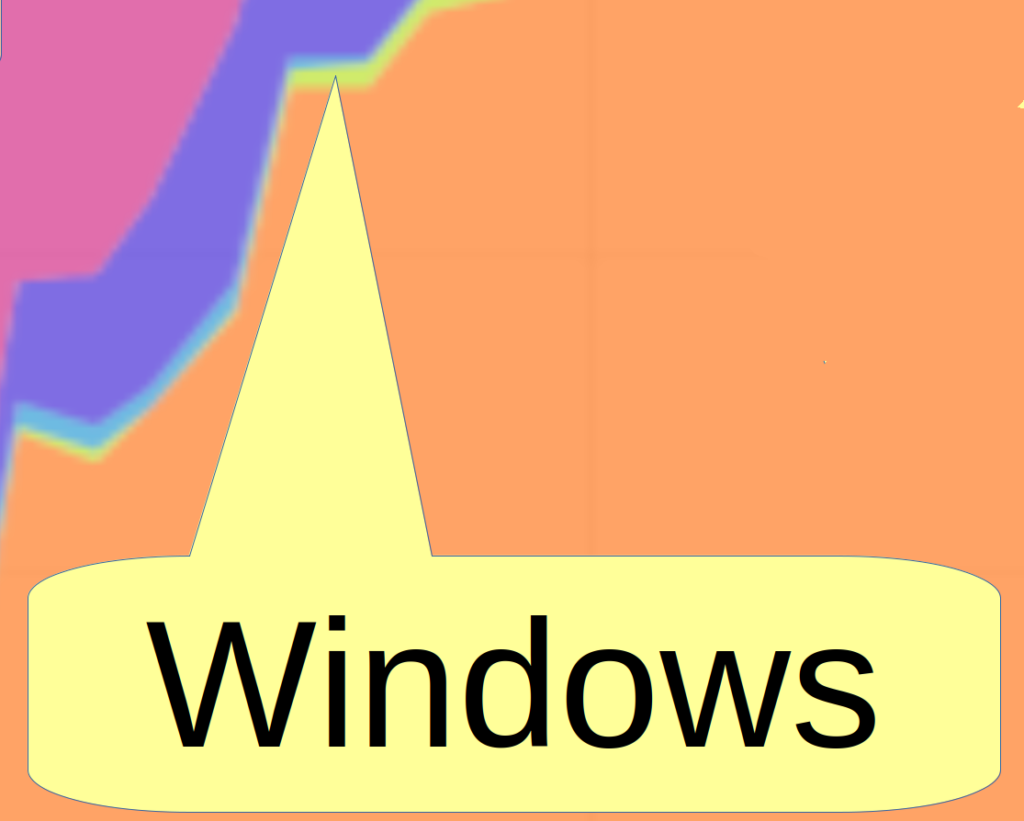
Windows peaked at 4 out of 500 around 2008. Here is the zoomed view:
The conclusion is clear: when it comes to specifying, designing, and deploying highly professional, powerful, strategic, and industrial-grade computing systems, there is only one choice: Unix/Linux (the distinction between the two is minimal in this context). These systems are not built on small-scale, unreliable operating systems designed for gaming, video editing, or visually appealing desktop interfaces.
When serious work is at stake,
a professional-grade operating system
is essential.
Evolution of the GPL
As threats to Free Software and software user rights have evolved over time, so has the GPL. The current version is GPL 3.0, which is compatible with earlier versions. However, software licensed under a specific GPL version cannot revert to a previous version.
Advantages of the GPL
When a company like Abil’I.T offers GPL-licensed software, it typically falls into one of two categories:
- The company fully owns the source code (e.g., MySQL, OpenOffice).
- The company acquired the source code under the GPL (e.g., Scada-LTS, based on a GPL-licensed version of Scada-BR).
Why does this distinction matter ?
It is critical for end users. A company that fully owns the source code from the outset can, at any time, close the source code, forcing users into a proprietary software lock-in. This is a real risk: one that should never be accepted, especially if the software is a key resource for managing strategic assets.
On the other hand, a company like Abil’I.T, which obtained the base source code under the GPL, cannot legally close the source code. Users are guaranteed access to it at all times, retaining all the rights of Free Software, including:
- No usage restrictions (amount of concurrent user sessions, screens, …)
- No data processing limits (unlimited datasources, storage, …)
- No hardware restrictions (e.g., CPUs, cores, RAM, storage, …)
- No geographical or political restrictions (e.g., no bans on “sensitive” technologies or military applications, …)
- Full rights to modify or correct any part of the software
- Full rights to add new functionalities (make it evolve to match your new needs, …)
Basically, no restriction at all but the one that says that…
If you distribute the software
(or any modified version)
you must do so
under the GPL license terms.
Why the GPL Matters
The GPL ensures the long-term sustainability of your software solution, regardless of what happens to the original developer. Because you own the source code and the right to maintain it, you are protected from vendor lock-in.
As a Free Software-compatible license, the GPL grants you unrestricted rights to use the software for any purpose, forever.
This is why and how we develop Scada-LTS: as a perfect example of sustainable, user-controlled software. Abil’I.T. is commited to
sustainable software
for a sustainable world.